The Last Manuals: Three Pedals Are Becoming an Endangered Species
The Last Manuals: Three Pedals Are Becoming an Endangered Species
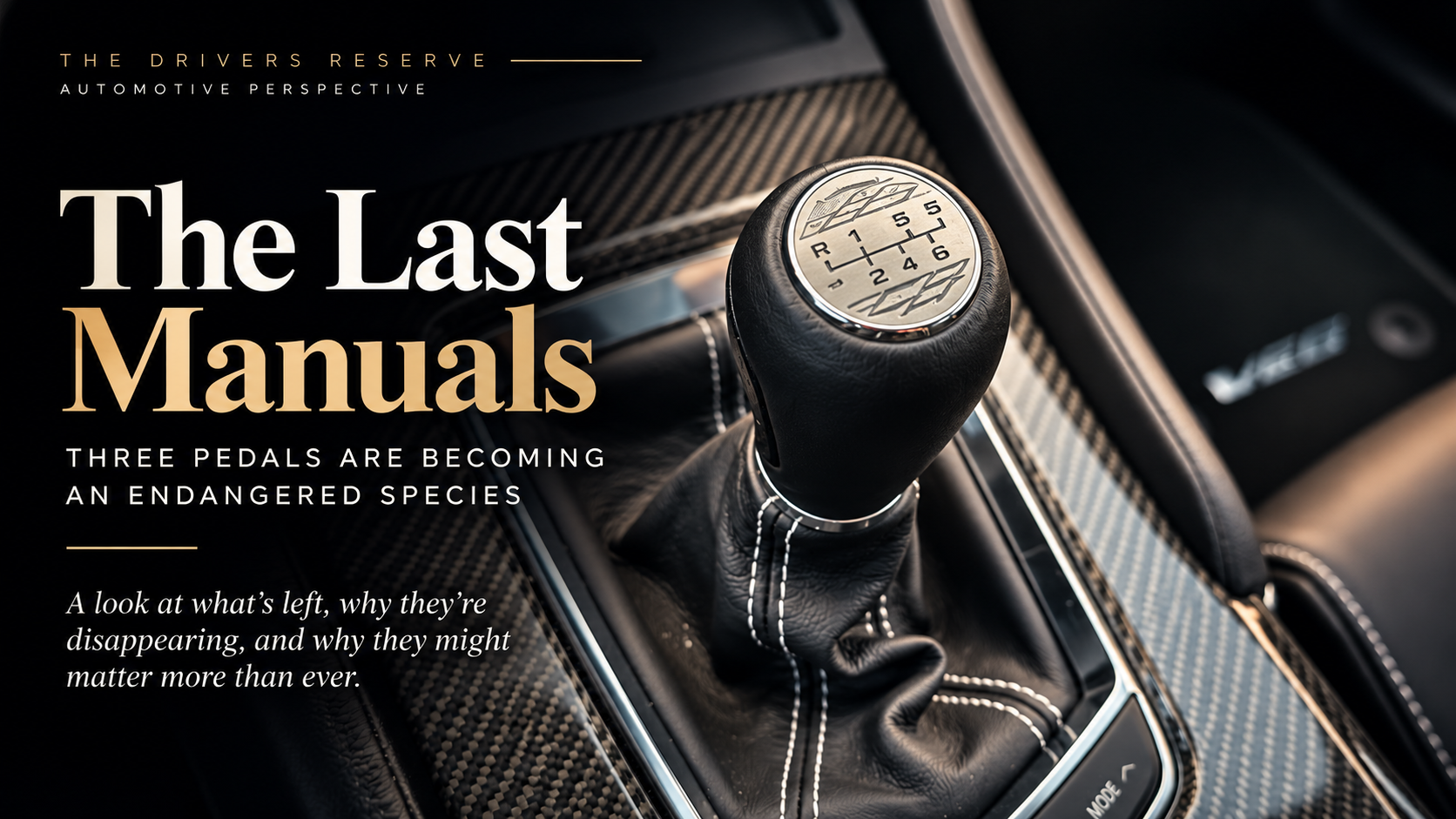
There was a time when driving a manual wasn't special. It wasn't an enthusiast option or something manufacturers bragged about. For millions of Americans, it was simply how you drove a car.
Today, only about 24 new models remain available in the U.S. with a manual transmission (“Cars With Manual Transmissions”). The bigger picture is even more surprising. According to the U.S. Environmental Protection Agency, manual transmissions were found in nearly 35 percent of new vehicles in 1980. Since 2021, they have accounted for less than one percent of production (U.S. Environmental Protection Agency 79).
We went from roughly one out of every three new vehicles being manual to fewer than one out of every hundred. So what happened?
When the Manual Was the Practical Choice
It's easy to forget that manuals weren't always about having fun. For years, they were often cheaper, simpler and more efficient than automatics.
Then automatic transmissions got really good. More gears, faster shifts and better efficiency changed the equation. The EPA reports that around 2012, the average automatic transmission surpassed the manual in number of gears. Modern automatics can now provide better efficiency and performance (U.S. Environmental Protection Agency 79).
Today, the automatic is usually faster, easier and, in many cases, more efficient. So why would anyone still want a manual?
Because driving isn't always about choosing the easiest option.
The Manual Gives You Something to Do
A manual makes you part of the process. You choose the gear. You operate the clutch. You learn the bite point, the engine and eventually the rhythm of the car. There's something satisfying about getting a downshift right or running through a good road without thinking about what your hands and feet are doing.
Is a modern automatic faster? Absolutely. But speed isn't everything. Sometimes involvement is what makes a car memorable.
The Last 24
The good news is there are still some great cars keeping the manual alive. The Mazda MX-5 Miata, Toyota GR86 and Subaru BRZ remain relatively affordable manual sports cars. The Subaru WRX, Hyundai Elantra N, Honda Civic Si and Toyota GR Corolla combine three pedals with everyday practicality.
Then there are the serious performance cars. The Ford Mustang, Nissan Z, Civic Type R and Acura Integra Type S can still be had with manuals. BMW continues to offer them in the M2, M3 and M4. Porsche keeps the manual alive in certain versions of the 911, and Lotus offers one in the Emira (“Every New Car”).
Then there's the Cadillac CT5-V Blackwing: a 668-horsepower supercharged V8, rear-wheel drive and a six-speed manual. A car like that almost feels like it shouldn't exist anymore.
Even the truck and SUV world has a few survivors. The Toyota Tacoma, Ford Bronco and Jeep Wrangler still offer clutch pedals.
But that's the point. We can actually sit here and name most of them.
Twenty or thirty years ago, listing every manual vehicle available in America would have been pointless. Today, there are only about two dozen left.
And the List Is Getting Shorter
Even some of today's survivors are already on borrowed time. The Toyota GR Supra is a perfect example.
When Toyota brought the Supra back, enthusiasts immediately asked one question: Where's the manual? Eventually, Toyota listened and paired the 3.0-liter Supra with a six-speed gearbox. Now it's already leaving.
Toyota has confirmed that production of the fifth-generation Supra is ending, bringing the current generation—and its six-speed manual—to a close (Toyota Motor North America).
That's the story of the modern manual transmission. One by one, they disappear.
Maybe We Didn't Realize What We Had
Cars are objectively better today in almost every measurable way. They're faster, safer, more efficient and more capable.
But I've always thought there's a difference between a car being impressive and a car being memorable.
Some of the cars enthusiasts love most aren't perfect. Heavy steering. Mechanical noises. Analog gauges. Engines that need to be revved. Gearboxes that take some effort. Those little imperfections create character.
The manual transmission may be one of the best examples. Nobody really needs one anymore, and that's exactly what makes its disappearance interesting.
The Specification May Matter More Than Ever
There's another side to this that I think will become increasingly important: specification.
The collector market has always cared about the details, engine, transmission, color, options, production numbers, documentation, condition and provenance. Sometimes one box checked on an original order sheet can completely change how enthusiasts look at a car years later.
That doesn't mean every manual car built today will become collectible. But imagine two otherwise similar enthusiast cars twenty years from now. One has the transmission almost everyone ordered. The other has a clutch pedal from an era when manuals represented less than one percent of new-vehicle production.
Which one tells the more interesting story?
As manuals become harder to find, transmission choice could become an increasingly important part of what makes certain specifications desirable.
Scarcity has a funny way of making yesterday's ordinary features feel special.
Enjoy Them While They're Here
The manual transmission isn't dead yet, but it's hard to ignore where things are heading. We've gone from nearly 35 percent of new vehicles in 1980 to less than one percent today, with only about two dozen new manual models remaining in America (U.S. Environmental Protection Agency 79; “Cars With Manual Transmissions”).
We may be looking at one of the last generations able to walk into a dealership and buy a traditional manual-transmission car new. Maybe that's why these cars deserve a little more appreciation while they're still here.
Not because they're faster, more efficient or easier.
But because driving one requires something from you.
You aren't just telling the car where to go. You're part of what makes it go.
And in an automotive world becoming more automated every year, that connection may end up being worth remembering.
The Drivers Reserve
Sourcing the Cars Worth Keeping.
Works Cited
“Cars With Manual Transmissions.” Car Curious, 25 Aug. 2026, getcarcurious.com/registry/manual-transmissions.
“Every New Car You Can Still Buy with a Manual Transmission.” Car and Driver, 28 Jan. 2026, caranddriver.com/features/a62909763/manual-transmission-cars-2025/.
Toyota Motor North America. “Take One Last Lap in the Toyota GR Supra MkV Final Edition.” Toyota USA Newsroom, 3 Apr. 2025, pressroom.toyota.com/take-one-last-lap-in-the-toyota-gr-supra-mkv-final-edition/.
U.S. Environmental Protection Agency. The 2025 EPA Automotive Trends Report: Greenhouse Gas Emissions, Fuel Economy, and Technology since 1975. EPA-420-R-26-001, Feb. 2026, www.epa.gov/system/files/documents/2026-02/420r26001.pdf.